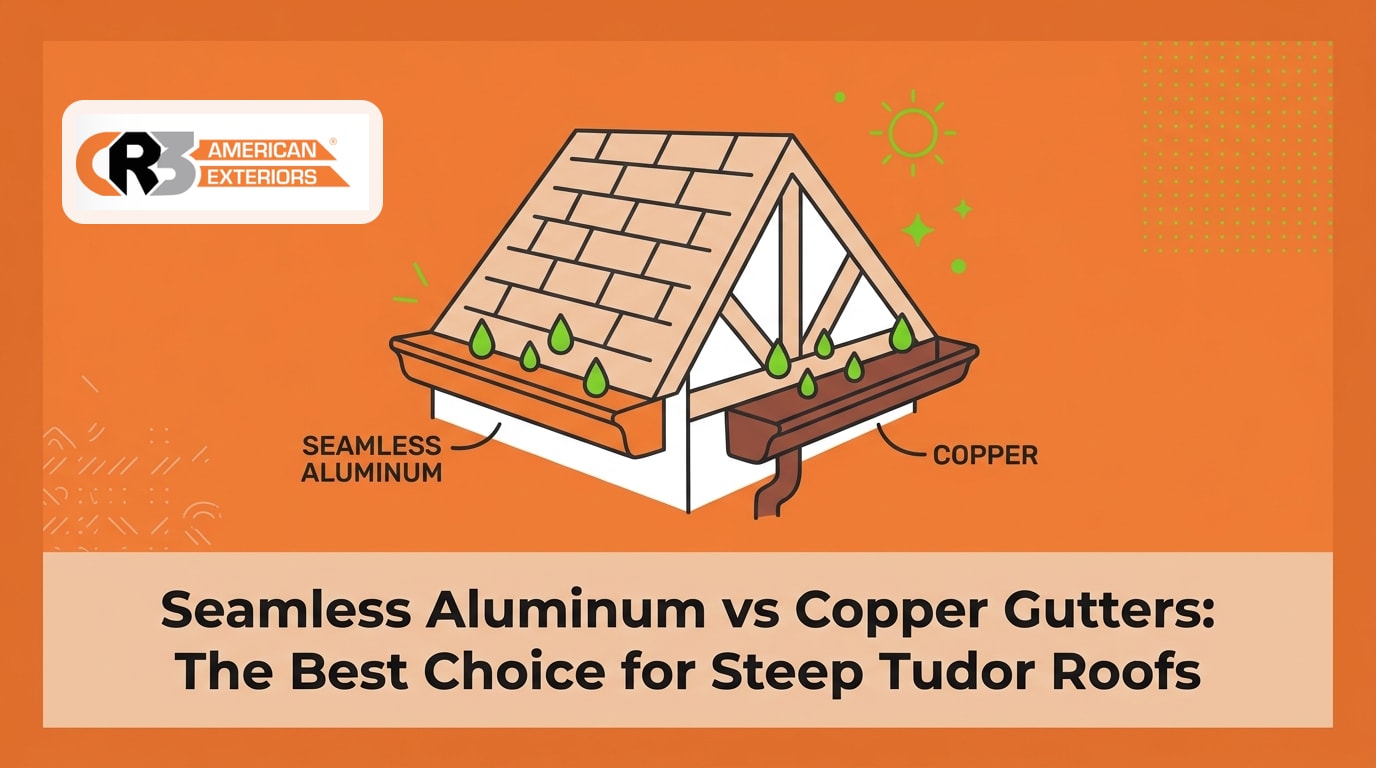
Seamless Aluminum vs Copper Gutters: The Best Choice for Steep Tudor Roofs
Nov 7, 2026
The Architectural Dilemma: Aesthetics vs. Winter Performance
Water is pouring over the edge of your roofline, bypassing the drainage system entirely during heavy downpours, and pooling around your foundation. At CR3 American Exteriors, we frequently help homeowners evaluate seamless aluminum vs copper gutters for historic properties, where they face a distinct challenge: balancing historical architectural accuracy with modern drainage performance. Managing heavy late-fall leaf loads and preventing ice dams on steeply pitched Tudor home roofs requires a system capable of handling high-velocity runoff.
Tudor architecture is renowned for its steeply pitched roofs, intersecting gables, and classic detailing. However, those steep pitches create a significant vulnerability during heavy precipitation. Rainwater accelerates rapidly down the slope, hitting the eaves with much greater force and volume than it would on a standard ranch-style home. If the drainage system lacks the proper capacity or structural design, the water simply shoots over the edge.
The decision you face is a matter of priorities. Do you maintain the exact historical look of traditional half-round profiles, or do you upgrade to a high-capacity system that prioritizes practical debris and ice management? With late fall (November) heavy leaf drop and pre-winter freeze prep rapidly approaching, our team stresses that making this decision before freezing temperatures lock in is critical to protecting your home’s foundation, siding, and fascia.
The Physics of Water Velocity on Steep Tudor Roofs
To understand why specific drainage profiles are necessary, we have to look at the underlying mechanics of steep-slope roofing. The pitch of your roof directly dictates the velocity and volume of water that your drainage system must manage during a storm.
The mechanics of steep pitch runoff: A standard roof might have a 4/12 or 6/12 pitch, meaning the roof rises 4 to 6 inches for every 12 inches of horizontal run. In our years of restoring exteriors in Hanover, PA, we see Tudor homes frequently featuring pitches of 10/12, 12/12, or even steeper. This steep angle drastically reduces the time it takes for rainwater to travel from the ridge to the eaves. The water gathers kinetic energy, arriving at the roofline rapidly and in concentrated volumes.
This reality requires specific water displacement engineering principles. When water hits the trough at high velocity, the shape and depth of the channel determine whether the water is captured or expelled.
- Volume capacity: K-style seamless aluminum profiles can handle roughly twice the water volume of traditional half-round profiles of the exact same width.
- Shape dynamics: The flat back of a K-style profile sits flush against the fascia board, while the rigid, contoured front acts as a barrier to catch fast-moving water.
- Overspill risks: Inadequate capacity leads to immediate overspill during heavy rainstorms, which can erode landscaping, flood basements, and rot exterior trim.
When our team compares K-Style seamless aluminum vs traditional half-round profiles, the physics strongly favor the K-style shape for any roof with a steep pitch. The traditional half-round shape, while beautiful, features a shallower trough and a curved front lip that fast-moving water can easily overshoot.
Material and Profile Breakdown: Seamless Aluminum vs Copper Gutters
Capturing the right look for a historic home is important, but preventing water damage is non-negotiable. When choosing the best gutter material for your home, a direct, objective comparison of the two primary materials and their standard shapes reveals significant differences in performance and maintenance.
Structural rigidity is a primary factor. We roll-form seamless aluminum on-site to the exact dimensions of your roofline, eliminating the seams that eventually serve as weak points. Copper, particularly in traditional half-round installations, is often soldered at the seams. Over time, thermal expansion and contraction can stress these joints, leading to leaks.
Aesthetically, the two materials offer different paths. Copper is prized for its living finish, gradually developing a natural green or brown patina over several years that perfectly complements stone and brick exteriors. Aluminum, on the other hand, relies on a baked-on enamel finish. While it doesn’t offer a natural patina, it provides color-matching versatility, allowing you to select a shade that blends seamlessly with your home’s trim.
| Feature | Half-Round Copper | K-Style Seamless Aluminum |
|---|---|---|
| Water Capacity | Lower (shallower trough) | High (handles 2x the volume) |
| Freeze Resistance | Vulnerable at soldered seams | High (seamless structural rigidity) |
| Debris Shedding | Prone to rapid clogging | Accommodates more debris before backing up |
| Aesthetic Authenticity | Historically accurate for Tudors | Modern profile, but highly customizable colors |
The Allure and Limitations of Copper Half-Rounds
Copper half-rounds provide unmatched historical accuracy for Tudor homes and other classic architectural styles. The curved profile and distinctive brackets create a timeless, high-end appearance that many preservationists prefer. However, copper is a significantly heavier material. This added weight places more constant strain on the fascia board and the specialized mounting hangers required to support it. Furthermore, we often observe that the lower water capacity of the half-round shape means it frequently struggles with the high-velocity runoff generated by steep gables.
The Practical Superiority of K-Style Aluminum
K-style seamless aluminum offers distinct practical advantages. The continuous, seamless design eliminates the weak points where leaks most commonly form. The flat back allows the system to be mounted directly and securely to the fascia, while the rigid front handles higher water volumes effortlessly. Because aluminum is a much lighter material, it reduces the overall structural strain on the home’s exterior, even when full of heavy rainwater.

Surviving the Freeze: Ice Dams and Winter Weight Loads
Winter weather introduces a completely different set of threats to your home’s exterior drainage. When precipitation shifts from rain to snow and ice, the material and shape of your system are tested to their limits. Solid ice weighs approximately 57 pounds per cubic foot. When a trough fills with ice, it places massive, sustained strain on the fastening systems holding it to your home.
Our CR3 American Exteriors crews know firsthand that Hanover, PA averages over 25 inches of snow annually and experiences severe winter freeze-thaw cycles. During the day, snow melts on the warmer upper sections of the roof, runs down to the colder eaves, and refreezes. This cycle makes high-capacity, freeze-resistant systems necessary to protect the property.
Freeze-thaw cycles specifically affect half-round copper seams. As ice expands, it pushes against the soldered joints. Over consecutive winters, this expansion and contraction can lead to seam separation and structural failure.
The seamless advantage: The structural rigidity of seamless aluminum excels in resisting warping under heavy snow and ice loads. Because there are no seams to split, the continuous channel maintains its integrity even when subjected to the expansion of solid ice. Furthermore, because the K-style profile handles higher volumes of water, it promotes proper water flow during the melt phase, which is critical for preventing the formation of destructive ice dams that can force water up under your roofing shingles.
Combating Late-Fall Leaf Drop and Debris
Before the snow arrives, homeowners must navigate the seasonal debris challenges that compound water velocity and freezing issues. We constantly remind our clients that the specific timing of late November leaf drops in Pennsylvania directly precedes freezing rain, creating a very narrow window for critical home protection.
Rapid leaf accumulation clogs traditional half-round profiles quickly. Because the trough is shallower and narrower at the top, leaves mat down and create a dam almost immediately. When late fall (November) heavy leaf drop occurs, these systems require constant monitoring to ensure they remain clear.
The danger of clogged channels just as pre-winter freezing rain begins cannot be overstated. If the trough is already full of wet, decomposing leaves, there is zero capacity for freezing rain. The water will immediately spill over, forming dangerous icicles and thick ice sheets on walkways below.
The K-style profile accommodates debris better while maintaining water flow. The wider top opening and deeper channel allow a certain amount of debris to settle while still permitting water to flow underneath and exit through the downspouts. Regardless of the material you choose, clearing systems before the first deep freeze is a mandatory maintenance step to ensure winter readiness.
Honest Advice: Prioritizing Functional Home Protection
When standing at the crossroads of aesthetics and performance, the most practical, reliable choice for steep roofs in freezing climates is K-style seamless aluminum. The physics of water displacement and the realities of winter weight loads demand a system built for high capacity and structural endurance.
We acknowledge that copper is beautiful, historically accurate, and a premium architectural feature. However, for managing heavy water volume off a steep Tudor pitch, it is often not the most practical solution. Homeowners should base their investment on architectural physics and climate reality rather than aesthetics alone.
At CR3 American Exteriors, our team focuses on honest, transparent recommendations—backed by our Dollar Back Nail Guarantee—to determine what actually works best for your home’s roof pitch, rather than just upselling the most expensive copper materials. Modern aluminum profiles can beautifully complement historic home exteriors, providing the color-matching versatility you want with the high-capacity performance your property requires.
Frequently Asked Questions About Gutter Materials and Shapes
Which gutter style handles heavy rain and snow best?
The K-style profile handles heavy rain and snow significantly better than traditional shapes. Because it has a flat back and a deep, contoured front, it can carry roughly twice the water volume of a half-round system of the same width. This deep channel also provides superior structural rigidity when supporting the heavy weight of winter snow and ice.
Why choose K-style over half-round gutters?
In our experience, most homeowners choose K-style systems for their superior water capacity and seamless durability. While half-round profiles offer a specific historical look, they are shallower and more prone to overspill during heavy downpours, especially on homes with steep roof pitches. K-style systems also sit flush against the fascia, providing a more secure mounting surface.
Do copper gutters hold up in freezing weather?
Copper can withstand cold temperatures, but the traditional soldered seams are vulnerable to freeze-thaw cycles. As ice expands inside a half-round copper system, it places immense pressure on the joints, which can eventually separate or crack. Seamless aluminum provides better resistance to this specific type of winter expansion damage.
How much longer do copper gutters last than aluminum?
Copper is exceptionally durable and can last for decades, often outlasting the roof itself if properly maintained. Aluminum systems also have a long lifespan, typically providing excellent service for many years before needing replacement. However, the lifespan of any system depends heavily on keeping it clear of debris and ensuring it is properly fastened to handle local snow loads.
Are seamless gutters necessary for steeply pitched roofs?
Seamless systems are highly recommended for steeply pitched roofs because of the water velocity involved. Steep roofs shed water rapidly, hitting the trough with high force. A seamless design eliminates the weak points and joints that high-velocity water can exploit, preventing leaks and ensuring the water is safely routed to the downspouts.
How does late-fall debris impact traditional gutter profiles?
Late-fall debris quickly overwhelms traditional half-round profiles due to their shallower depth. Leaves and pine needles mat down rapidly, creating dams that block water flow. If this debris is not cleared before the first freeze, the trapped water turns to solid ice, adding massive weight to the fascia and increasing the risk of destructive ice dams.
Secure Your Tudor Home Before Winter Hits
Leaving a steep Tudor roof unprotected with an inadequate or failing drainage system during winter is a risk your property cannot afford. High-velocity runoff, heavy leaf loads, and expanding ice demand a system engineered for performance. Schedule an expert evaluation of your current drainage setup today. By upgrading to a high-capacity seamless aluminum system, you ensure your historic home remains thoroughly protected against whatever the winter season brings.