The Physics of Ice Dam Formation: Why Attic Insulation Matters More Than Shingle Quality
Nov 3, 2026
The Cold Hard Truth: Why New Shingles Won’t Stop Winter Roof Leaks
Water is dripping from your ceiling during a heavy freeze, and while your first instinct might be to blame your exterior roofing materials, understanding The Physics of Ice Dam Formation: Why Attic Insulation Matters More Than Shingle Quality will save you from a costly misdiagnosis. At CR3 American Exteriors, our team receives frantic calls every winter from homeowners dealing with heavy icicles hanging from their gutters and water stains spreading across their drywall. Naturally, when a roof leaks, the immediate assumption is that the shingles have failed, deteriorated, or blown off, prompting urgent requests for a complete roof replacement.
Before you make a major investment, you need to understand the common reasons why roof leaks happen during the colder months, and how you can actually prevent ice dams on your roof by addressing the root cause.
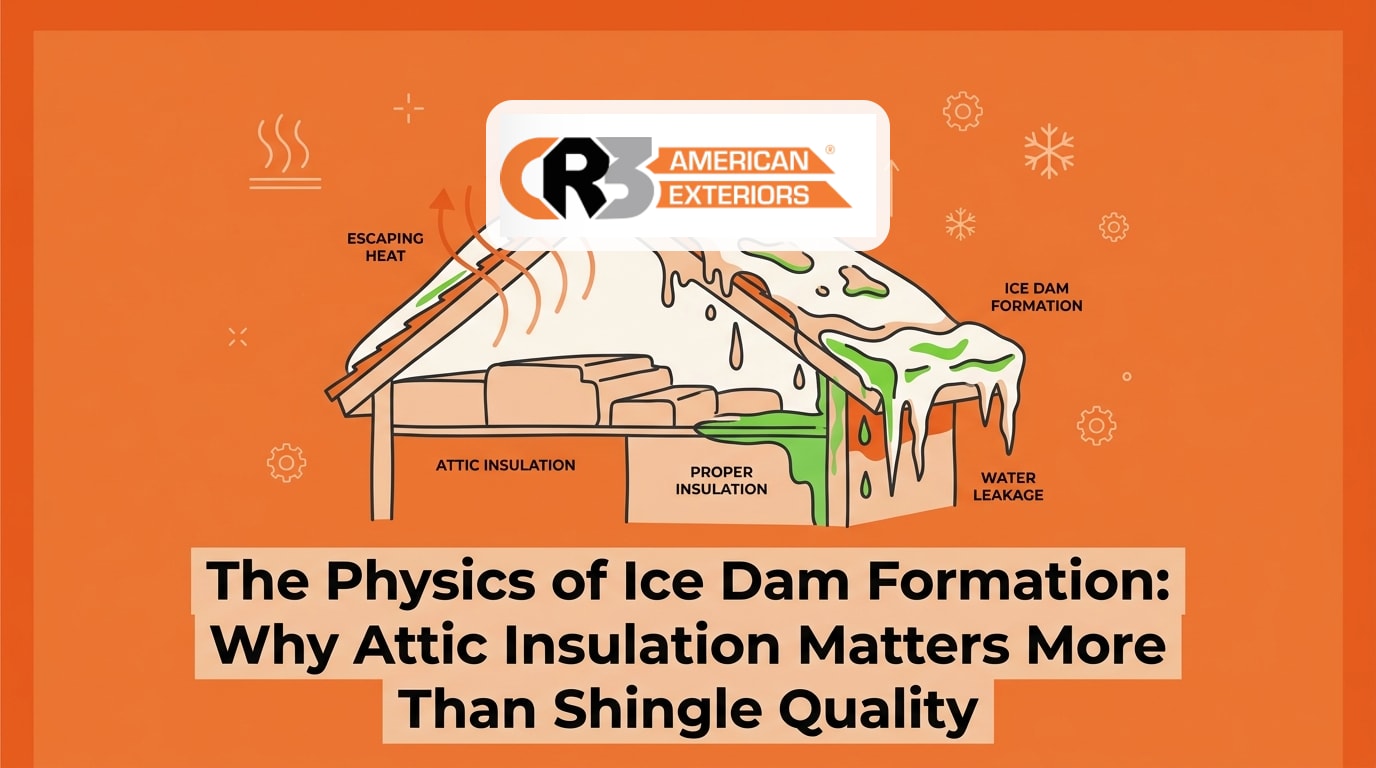
In our years of field experience, we’ve found that winter leaks are rarely caused by defective shingles. Instead, they are the direct result of a localized freeze-thaw cycle driven by escaping indoor heat. When warm air from your living space penetrates the attic during early winter snowfalls, it artificially warms the upper sections of your roof deck. This escaping heat melts the accumulated snow, sending water running down toward the eaves. Because the eaves extend past the heated exterior walls of the house, they remain at freezing temperatures. The melted snow hits this cold edge, refreezes, and begins to build a solid wall of ice.
In cold-weather regions like Hanover, PA, this specific weather pattern—early winter snowfalls followed by freezing overnight temperatures—triggers this exact cycle. Installing a brand-new roof without fixing the underlying thermal boundary will simply result in a new roof with the exact same ice dams. Until you stop the heat from escaping into the attic, no amount of fresh asphalt will keep the water out.
| The Symptom | What Homeowners Often Assume | The Actual Scientific Cause |
|---|---|---|
| Massive icicles on gutters | The gutters are clogged or broken. | Heat escaping the attic is melting roof snow, which refreezes at the cold eaves. |
| Water leaking near exterior walls | The shingles at the edge of the roof are old or missing. | An ice dam has forced liquid water backward and upward under the roofing materials. |
| Frost inside the attic space | There is a hole in the roof letting snow in. | Warm, moist indoor air is bypassing the ceiling and condensing on the freezing roof deck. |
The Mechanics of a Roof Freeze-Thaw Cycle
To truly understand why your roof leaks in January, we always advise looking at the thermodynamics of your house. The process of ice dam formation is a predictable sequence of events known as a thermal boundary failure. This occurs when the barrier between your conditioned living space and your unconditioned attic fails to contain your home’s heat. When fluctuating late fall and early winter temperatures in areas like Hunt Valley, MD, or even during unusual cold snaps across North Carolina communities like Huntersville, Concord, Mooresville, Salisbury, Charlotte, Kannapolis, and Cornelius, create cycles of daytime melting and rapid overnight freezing, the environmental conditions become perfect for rapid ice dam formation.
Here is the exact step-by-step physical process our diagnostic teams observe that leads to structural water intrusion:
- The Thermal Bypass: Heat from your home’s interior bypasses the ceiling boundary due to insufficient insulation or unsealed air gaps. This warms the ambient air inside the attic space.
- The Deck Warming: The warm attic air rises and transfers its heat to the underside of the upper roof deck through conduction. Even when outside temperatures are well below freezing, the shingles directly above the main living area become artificially warm.
- The Localized Melt: Snow resting on these artificially warmed upper ridges begins to melt. The resulting liquid water flows downward along the slope of the roof, traveling beneath the insulating blanket of the remaining snowpack.
- The Refreeze and Damming: As the water reaches the lower eaves and overhangs—which extend beyond the exterior walls and receive no artificial heat from the house—it encounters freezing surface temperatures. The water rapidly refreezes, building a solid ridge of ice along the gutter line.
- The Backup: As this cycle continues, the wall of ice grows taller. Subsequent snowmelt runs down the roof, hits the ice dam, and has nowhere to go. It pools behind the dam and is eventually forced backward, traveling up and under the shingles until it finds a path through the underlayment and into the home.
How Heat Loss Bypasses the Ceiling
The heat transfer that initiates this entire destructive cycle happens through two primary scientific mechanisms: convection and conduction. Both must be managed to keep the roof deck cold.
- Convection currents: This is the physical movement of warm air. Convection pulls heated air from your living spaces up into the attic through unsealed bypasses. Common culprits we identify include unweatherstripped attic hatches, unsealed recessed lighting fixtures, bathroom exhaust fans that vent into the attic instead of outside, and the gaps around plumbing stacks and electrical wire penetrations.
- Conduction transfer: This is the transfer of heat through solid materials. Even if every air leak is perfectly sealed, heat will still conduct directly through your ceiling drywall and into the attic space if there is not a thick enough layer of insulating material to slow the transfer.

The Thermal Boundary: Where Home Heat Loss Actually Happens
Your home’s thermal boundary is the continuous layer of insulation and air sealing that separates the heated interior from the freezing exterior. In most residential construction, this boundary sits flat on the attic floor. Attic insulation is the absolute primary defense against the thermal bypass that warms the roof deck and triggers the freeze-thaw cycle.
Many homeowners understand why insulation matters for keeping energy bills low, but its role in structural roof protection is often overlooked. Proper insulation is a universal principle. While our crews in Florida—serving Ocala, The Villages, Gainesville, Leesburg, Wildwood, Lady Lake, Hernando, Jupiter, Palm Beach Gardens, and West Palm Beach—focus heavily on keeping extreme heat out, the physics remain the same for keeping winter heat in. The U.S. Department of Energy explicitly recommends up to R-60 attic insulation for cold weather climates. The “R-value” is a scientific measurement of a material’s resistance to conductive heat flow. The higher the R-value, the greater the insulating power.
Achieving an R-60 rating usually requires significantly more insulation than older homes were originally built with—often translating to 16 to 20 inches of blown-in fiberglass or cellulose material. Without this sufficient R-value, no amount of exterior roof waterproofing, heavy-duty shingles, or specialized underlayment can permanently stop ice dam formation. The heat will simply continue to escape, the snow will continue to melt, and the ice will continue to build.
Tackling this upgrade during your November pre-winter preparation ensures that the thermal boundary is intact before the first heavy snowfall, offering reliable heating performance and peace of mind during your holiday-season home prep. By keeping the heat trapped inside your living space, the attic remains at a temperature closely matching the outdoors, which means the snow on the roof stays frozen and melts naturally and evenly when the weather actually warms up. As an added bonus, generic federal tax credits or local utility incentive programs may apply to qualifying insulation upgrades, so we always advise readers to verify current programs with their utility or a tax professional.
Balancing the Equation: The Role of Intake and Exhaust
While thick insulation slows conductive heat transfer, it is practically impossible to stop 100% of your home’s heat from entering the attic. This is where the second half of the physics equation comes into play: roof ventilation. Insulation slows the heat down, but proper ventilation actively removes the residual heat that inevitably makes it into the attic space.
The science of roof ventilation relies on a balanced system of intake and exhaust to maintain continuous airflow. This airflow is driven by the natural physical properties of thermal buoyancy (warm air rising) and the Bernoulli principle (wind blowing over the roof creating negative pressure).
Our roofing specialists ensure a properly balanced system includes two main components:
- Intake ventilation at the soffits: Located under the eaves of the roof, soffit vents allow cold, fresh outdoor air to enter the lowest point of the attic space.
- Exhaust ventilation at the ridge: Located at the very peak of the roof, ridge vents allow the warmest air inside the attic to escape outside.
As the warm air rises and exits through the ridge, it creates a vacuum that pulls fresh, freezing air in through the soffits. This continuous, passive airflow flushes out any escaped indoor heat and keeps the entire roof deck at ambient outdoor temperatures, preventing the localized melting that causes ice dams.
One of the most common mistakes our crews see in homes across Ohio—including Columbus, Dublin, Grove City, Reynoldsburg, Hilliard, Westerville, and Gahanna—and Hanover, PA, is improper insulation installation that accidentally blocks the soffit vents. When homeowners or inexperienced contractors blow new insulation into the edges of the attic without installing proper protective baffles, they choke off the intake air. Without intake, the ridge vents cannot exhaust the warm air, the attic temperature spikes, and ice dams form almost immediately after the next snowstorm.
The Shingle Myth: Why Thicker Roofs Can’t Defeat Ice Expansion
There is a persistent misconception in the home improvement world that upgrading to heavier, premium architectural shingles will somehow solve winter leak problems. The marketing suggests that a thicker, heavier roof covering will naturally resist the elements better. However, this ignores the fundamental physics of freezing water.
When liquid water transitions into solid ice, it expands in volume by approximately 9%. This expansion process creates an immense, relentless mechanical force. As the water pools behind an ice dam and begins to freeze in the tight spaces between your shingles, that 9% expansion easily generates enough pressure to lift the heaviest premium shingles, pry out roofing nails, and tear through synthetic underlayments.
Because roof problems start in the attic, buying a luxury shingle system without addressing your attic’s health is a wasted investment. The ice will simply destroy the new materials just as it destroyed the old ones.
The CR3 American Exteriors Diagnostic Difference:
Many roofing contractors will gladly sell you a full roof replacement the moment you complain about winter leaks. At CR3 American Exteriors, we utilize a comprehensive diagnostic approach that focuses on honesty and root-cause analysis. We actively educate homeowners that a new roof will not fix a thermal boundary issue. We look at the health of the attic, the R-value of the insulation, and the balance of the ventilation before we ever recommend replacing the shingles on top.
While building codes do require the installation of ice and water shield—a rubberized, self-healing membrane installed along the eaves under the shingles—this material is only a secondary defense. It helps mitigate the interior damage when water backs up, but it absolutely does not stop the ice dam from forming in the first place. True prevention requires stopping the unnatural melt cycle.
Preparing Your Attic Before the Deep Freeze Sets In
Timing is everything when it comes to exterior home maintenance. Addressing your attic’s thermal boundary during your November pre-winter preparation is critical for homes in cold-weather climates. Once the heavy snow accumulates on the roof and the active freeze-thaw cycle begins, diagnosing and retrofitting insulation and ventilation becomes significantly harder, and the risk of emergency interior water damage skyrockets.
Taking proactive steps now ensures your home is ready to handle the worst late fall and winter weather without springing a leak. A professional assessment of your attic’s thermal boundary can identify air leaks and insufficient R-values before the first major snowfall.
Here is a checklist of critical pre-winter attic preparations we recommend:
- Verify the R-value: Measure the depth of your current attic insulation. If you can clearly see the tops of your ceiling joists, you do not have enough insulation to prevent heat loss.
- Inspect the soffit vents: Go outside and look under your eaves to ensure the intake vents are not painted shut or clogged with dirt. Inside the attic, verify that insulation has not spilled over and blocked the airflow path.
- Have professionals seal the bypasses: Ensure that the gaps around plumbing pipes, chimneys, and electrical conduits are properly sealed with expanding foam or fire-rated caulking by a qualified technician, and check the weatherstripping around the attic access door.
- Check the exhaust fans: Confirm that all bathroom and kitchen exhaust fans are ducted completely through the roof to the outside, rather than simply venting warm, moist air directly into the attic space.
- Schedule a diagnostic evaluation: Have a professional evaluate the balance of your intake and exhaust ventilation to ensure the system is capable of keeping the roof deck cold.
Frequently Asked Questions About Ice Dams and Attic Health
Why do I have ice dams with a new roof?
In our experience, ice dams form because of heat escaping from your home into the attic, not because of defective roofing materials. If you installed a new roof but did not upgrade your attic insulation and ventilation, the exact same thermal boundary failure is still warming your roof deck. The escaping heat melts the snow, which then refreezes at the cold eaves, creating ice dams regardless of how new your shingles are.
Will attic insulation stop ice dams?
Yes, proper attic insulation is the most effective way to stop ice dams from forming. By upgrading to the recommended R-60 insulation level, you create a strong thermal boundary that traps heat inside your living space. When the heat cannot escape into the attic, the roof deck remains cold, and the snow melts naturally and evenly from the sun rather than artificially from underneath.
Does roof ventilation prevent ice dams?
Roof ventilation works in tandem with insulation to prevent ice dams by flushing out any residual heat that makes it into the attic. A balanced system of soffit intake vents and ridge exhaust vents creates continuous airflow that keeps the underside of the roof deck at the same freezing temperature as the outside air. Without this ventilation, trapped heat will quickly warm the shingles and trigger the melting cycle.
How much insulation is needed to prevent ice dams?
For cold-weather regions, the U.S. Department of Energy recommends up to R-60 attic insulation to maintain a proper thermal boundary. Depending on the material used, this typically translates to roughly 16 to 20 inches of blown-in fiberglass or cellulose insulation. Having this depth ensures that conductive heat transfer is slowed enough to prevent the upper roof deck from warming up.
Can heat tape permanently fix an ice dam problem?
No, heat tape is only a temporary, topical symptom-management tool and does not fix the underlying problem. While zigzagging heated cables along your eaves can melt small channels through the ice to let water drain, it does absolutely nothing to stop the thermal boundary failure causing the initial snowmelt. Relying on heat tape wastes electricity and ignores the severe heat loss happening in your attic.
Address the Root Cause of Roof Leaks This Winter
Ice dams and winter roof leaks are ultimately a symptom of a thermal boundary failure, not a shingle defect. Throwing money at premium roofing materials without fixing the underlying physics of your home’s heat loss is a recipe for repeated frustration. By maintaining proper insulation levels and ensuring balanced airflow, you provide a permanent, physics-based solution to winter water intrusion.
Make your November pre-winter preparation count this year. If you want to permanently prevent ice dams on your roof, consult with the exterior experts at CR3 American Exteriors. We understand the science of attic health, air sealing, and thermal dynamics to keep your home safe, dry, and energy-efficient all season long.