Siding Repair Diagnostics: How Surface Moss Signals Hidden Moisture Damage Before Winter
Oct 30, 2026
Why That Green Tint on Your Exterior Is More Than Just a Cosmetic Issue
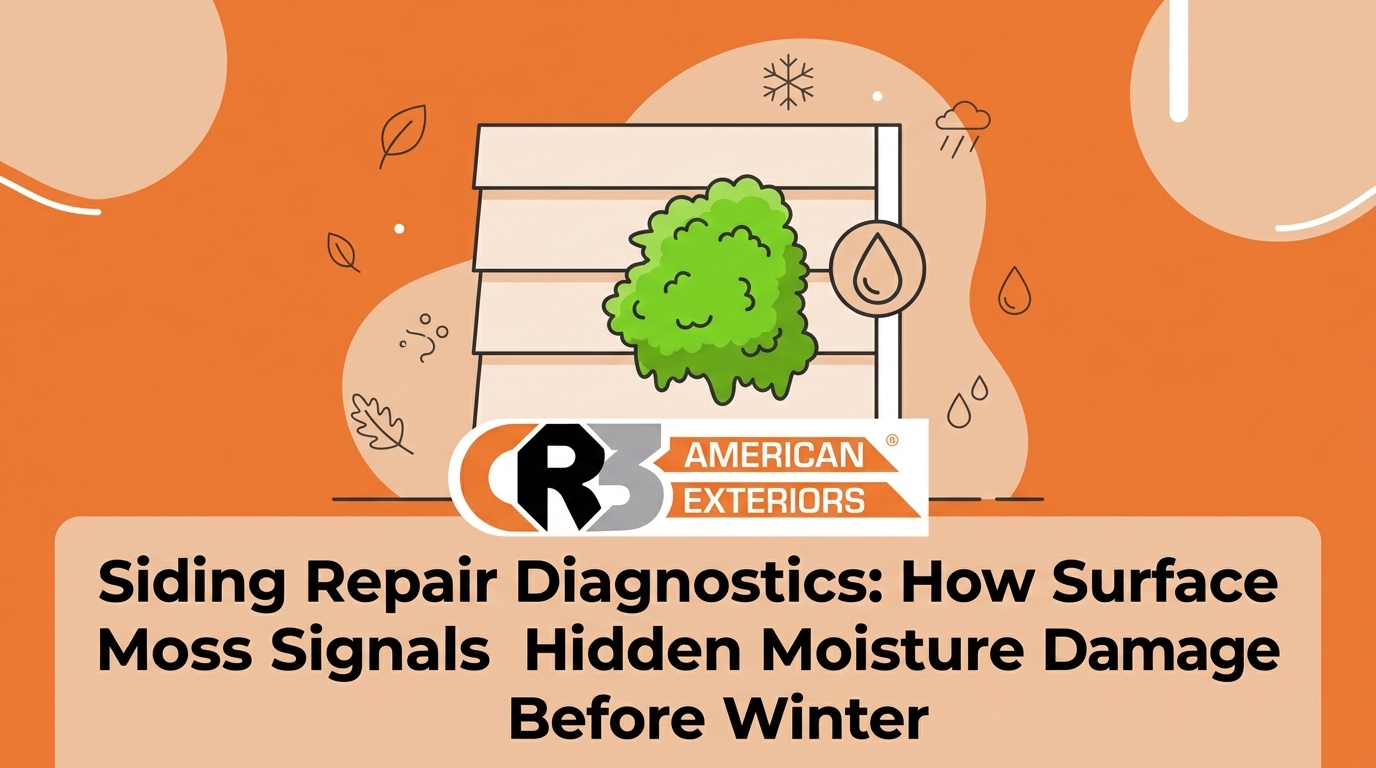
When that strange green tint spreads across the shaded side of your house, your first thought might be how to scrub it away. However, in our years of experience at CR3 American Exteriors, this discoloration is often the first warning sign that you need professional siding repair. As homeowners head outside for October yard cleanup amidst pre-winter dampness and falling temperatures, noticing green or black streaks on the exterior panels is incredibly common. Most people dismiss this as simple dirt or a bit of seasonal grime that just needs a good rinse. The reality is much more complex. That green film is an active, living biological ecosystem that has anchored itself to your home.
Surface growth is rarely an isolated issue. Algae, mildew, and moss do not randomly attach themselves to dry, healthy building materials. They are bio-indicators. A pattern we see often is that their presence is the most reliable early warning sign that an exterior wall is retaining far too much water. When moisture lingers on the surface rather than shedding quickly, it creates the perfect terrarium for these organisms to take root and multiply.
Addressing these early warning signs is a critical part of routine siding maintenance. If you treat the green tint as merely a cosmetic annoyance, you miss the opportunity to correct a failing moisture barrier before the damage reaches the structural wood beneath. By understanding what that moss is actually doing to your exterior panels, you can intervene early, saving the integrity of your home’s protective envelope.
The Environmental Triggers: What Feeds Moss and Algae?
Algae, mildew, and moss are opportunistic organisms. They require a very specific set of environmental conditions to thrive on exterior panels, and unfortunately, the typical residential landscape often provides exactly what they need. Understanding these triggers is the first step in diagnosing why your home’s exterior is staying wet enough to support biological growth.
- Heavy shade from nearby trees: Direct sunlight is the natural enemy of moss and algae. When large trees cast dense shadows over the north or east sides of a house, morning dew and post-storm moisture are never baked off by the sun. This prolonged dampness provides the hydration these organisms need to survive.
- High humidity and persistent moisture: Areas that experience heavy morning fogs, frequent rain, or generally high atmospheric humidity create a hospitable environment for spores to settle and germinate on the microscopic textures of your siding.
- Accumulation of dirt, dust, and tree sap: Siding panels are not a food source on their own. However, when windblown dust, pollen, and sticky tree sap accumulate on the surface, they create a nutrient-rich layer. The algae feeds on this organic debris while utilizing the trapped moisture to grow.
- Proximity to overgrown shrubs: Foundation planting that sits too close to the house restricts essential airflow. Without a steady breeze to dry the exterior walls, the microclimate between the bush and the siding remains permanently damp, accelerating moss development.
When multiple environmental triggers combine—such as a heavily shaded wall blocked by dense shrubs—the siding never truly dries out. This constant state of saturation is what transitions a wall from being slightly dirty to actively failing.
How Trapped Moisture Compromises Your Home’s Defense
The Problem: The journey from a thin layer of surface algae to severe structural water damage happens slowly, silently, and largely out of sight. Moss acts exactly like a natural sponge. Once established, it holds moisture directly against the siding panels for extended periods, preventing the material from shedding water the way it was engineered to do.
The Cause: As moss matures, its microscopic root systems (rhizoids) seek out tiny imperfections, seams, and overlaps in the siding. As these roots grow and expand, they can physically lift the siding panels away from the wall. This slight separation breaks the continuous weather envelope of the home. Once the panels are lifted, wind-driven rainwater easily infiltrates the home’s protective weather barrier, soaking the wood sheathing beneath.
The Solution: Prolonged exposure to this trapped water inevitably leads to underlying wood rot, compromising the structural integrity of the home and inviting pest infestations. Identifying the signs your siding is trapping moisture early is the only way to prevent a minor surface issue from escalating into a major structural failure. Routine inspections, especially in the fall, allow you to catch this physical separation before winter precipitation takes advantage of the compromised barrier.

Regional Climate Threats: From Southern Humidity to Northern Freeze-Thaw
Siding materials react very differently depending on your geographic climate and the severity of local seasonal shifts. What causes a panel to fail in one state might be entirely different from the primary threat just a few hundred miles away. Understanding how trapped moisture compromises exterior panels is crucial for homeowners navigating these distinct regional weather patterns.
In coastal and high-humidity zones, our crews see relentless, year-round algae and mildew pressure. For example, across our Florida service areas—including Ocala, The Villages, Gainesville, Leesburg, Wildwood, Lady Lake, Hernando, Jupiter, Palm Beach Gardens, and West Palm Beach, FL—the air is thick with moisture. The same applies to our North Carolina communities like Huntersville, Concord, Mooresville, Salisbury, Charlotte, Kannapolis, and Cornelius, NC. The lack of a deep winter freeze in these southern regions means biological growth never truly goes dormant. Here, the primary threat is the continuous, uninterrupted rotting of the underlying wood sheathing as moss perpetually holds dampness against the house.
Conversely, the mid-Atlantic and Midwestern regions face a much more violent physical threat. Homes in Columbus, Dublin, Grove City, Reynoldsburg, Hilliard, Westerville, and Gahanna, OH, as well as Hunt Valley, MD, and our primary service area of Hanover, PA, deal with severe freeze-thaw cycles during late fall and winter. A pattern we see often in these northern zones is that when October’s moss traps moisture behind the panels, that water sits dormant until the first hard freeze hits. When water turns to ice, it expands by roughly nine percent. This expansion forces the already lifted panels further apart. Worse, cold temperatures cause vinyl and composite materials to become brittle. The expanding ice shatters the weakened panels from the inside out, turning a moisture problem into an immediate need for physical replacement.
The Hidden Dangers of DIY Power Washing
When homeowners search for solutions regarding “cleaning green moss off siding in fall,” the most common advice they find involves renting a high-pressure washer. While blasting away the green algae with a 3,000-PSI nozzle might provide instant visual gratification, we highly recommend against it—it is often the worst possible action you can take for the health of your home.
Exterior siding is designed to shed water that falls downward, mimicking natural rain. It is not engineered to withstand highly pressurized water forced upward. Homeowners standing on the ground naturally spray at an upward angle to reach the second story. This easily drives gallons of water directly beneath the overlapping panels and straight through the soffit vents.
Once water is forced behind the sheathing, it has no easy way to evaporate. This trapped water accelerates hidden mold growth, saturates insulation, and rots the wooden framework of the house. Furthermore, improper power washing can permanently alter the texture of the material, strip away protective UV coatings, and completely void manufacturer warranties. Safe cleaning requires specialized soft-wash techniques and appropriate, biodegradable cleaning solutions that kill the biological growth down to the roots without relying on destructive high pressure.
Visual Cues That Point to Professional Siding Repair
Not all siding issues can be resolved with a thorough soft-washing. Once moisture has breached the barrier or freeze-thaw cycles have taken their toll, physical damage sets in. It is vital to know when a surface issue has transitioned into a structural one that requires professional intervention.
Inspecting for Buckling and Warping
- Sight down the wall: Stand at the corner of your house and look straight down the length of the wall. You should see crisp, straight lines. If you spot wavy, undulating lines, the panels have buckled.
- Check the interlocks: Identify areas where panels no longer snap tightly together. When moss lifts the seams or ice expands behind them, the locking mechanisms break, leaving the wall permanently open to the elements.
- Assess recent installations: Even recently installed materials can fail if the initial installation trapped moisture behind the vapor barrier, leading to new siding warping long before its expected lifespan.
Checking for Hidden Rot
- Look for hairline cracks: Inspect the lower panels closely for tiny spiderweb cracks caused by ice expansion during previous winters. These cracks will only grow larger as temperatures drop again.
- Press gently on the panels: Walk around the foundation and press gently on the exterior wall. A firm, solid resistance is normal. A spongy, soft, or yielding feeling indicates severe underlying wood rot that has compromised the sheathing.
- Monitor interior symptoms: Look for unexpected interior drafts near baseboards or sudden spikes in your heating bills, which indicate that the exterior envelope is no longer insulating the home.
Knowing how to properly fix warping siding requires addressing both the compromised exterior panel and the water-damaged weather barrier beneath it.
Professional Diagnostics: Determining Between Repair and Replacement
When surface moss leads to physical panel damage, a thorough exterior assessment goes far beyond surface aesthetics. A true diagnostic check evaluates the entire health of the home’s weather envelope. Professionals must determine whether the moisture damage is localized to a few shaded panels or if it indicates a widespread, systemic failure of the home’s exterior defense.
In many cases, replacing a few damaged sections is highly effective, provided the underlying weather barrier remains intact and the wood sheathing is dry. This targeted approach saves the structural integrity of the wall without the massive undertaking of a full tear-off. Full replacements are only necessary when the material has reached the absolute end of its lifespan, when the rot is extensive, or when the siding has become so brittle that attempting a localized fix would shatter the surrounding panels.
Our team at CR3 American Exteriors maintains a strict commitment to honesty and transparent assessments. The goal is to ensure homeowners only pay for the necessary repairs to secure their property, rather than being pushed into premature, full-scale replacements when a targeted intervention will solve the moisture problem perfectly.
Frequently Asked Questions About Siding Health and Biological Growth
Does moss ruin vinyl siding?
Yes, over time moss can ruin vinyl siding by physically lifting the panels and trapping moisture. While the vinyl material itself does not rot, the root systems of the moss wedge into the seams, breaking the interlocking mechanisms. Once those seams are open, water gets behind the vinyl, leading to severe rot in the wooden structure of the house.
Why is my siding turning green in the fall?
Your siding is turning green because fall brings increased dampness, heavy morning dew, and less intense direct sunlight. These conditions create the perfect environment for algae and moss spores to germinate. The organic matter that blew onto your house during the summer acts as a food source, allowing the green growth to bloom rapidly as temperatures cool.
Can power washing damage siding?
Yes, high-pressure washing is one of the most common ways homeowners accidentally damage their siding. Spraying water at an upward angle forces moisture directly beneath the overlapping panels and into the home’s wall cavity. It can also crack brittle panels, strip protective coatings, and void your manufacturer’s warranty.
How do you stop mold from growing on vinyl siding?
The most effective way to stop mold and algae is to eliminate the environmental conditions they need to survive. Trim back overgrown shrubs to improve airflow, cut back tree branches to allow more direct sunlight onto the walls, and schedule routine soft-washing to remove the dirt and sap that these organisms use as a food source.
When should siding be replaced instead of repaired?
Siding should be fully replaced when the material has become uniformly brittle, when it exhibits widespread warping and buckling, or when a professional inspection reveals extensive rot in the structural sheathing beneath. If the damage is localized to a small area and the underlying weather barrier is intact, a targeted repair is usually sufficient.
Will winter freeze-thaw cycles kill the moss on my exterior naturally?
No, winter weather will not solve a moss problem; it will actually make the underlying damage worse. While the moss may go dormant and turn brown during a freeze, the moisture it has trapped behind your siding will turn to ice. That expanding ice will crack the panels and widen the gaps, leaving your home more vulnerable when spring arrives.
Secure Your Home’s Exterior Before Winter Arrives
Fall is the critical window to address exterior moisture before freezing temperatures permanently damage your home. Ignoring the early signs of biological growth, like that creeping green tint on your shaded walls, can lead to incredibly costly winter freeze damage. As you notice the October pre-winter dampness settling in, take the time to evaluate your exterior walls. Reach out to our local professionals at CR3 American Exteriors to explore your siding repair options, ensure your moisture barrier is intact, and gain the peace of mind that your home is fully protected before the first snow flies.