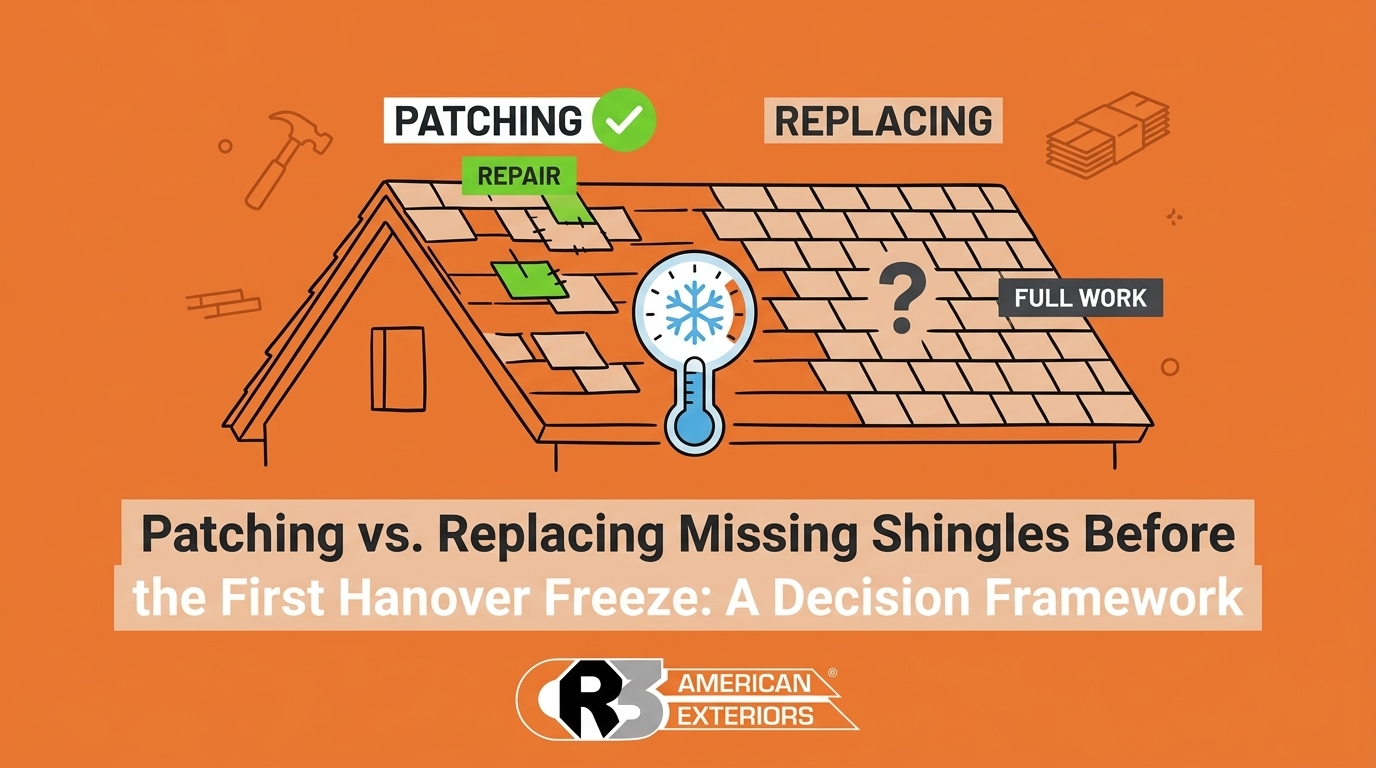
Patching vs. Replacing Missing Shingles Before the First Hanover Freeze
Oct 19, 2026
The Myth of the Quick Fix Before Winter
At CR3 American Exteriors, our team regularly sees the aftermath of temporary fixes. Slapping a quick square of asphalt over a bare spot on your roof does not mean your home is ready for winter. When you are weighing patching vs. replacing missing shingles before the first Hanover freeze, you have to look past the surface. A common myth among homeowners is that a fast, inexpensive dab of roofing cement and a single replacement tab will always carry a roof safely through the colder months. While this superficial approach might temporarily stop a light summer rain, winter weather introduces entirely different mechanical forces that tear weak repairs apart.
Many homeowners first notice these missing shingles during routine fall yard cleanup. You are raking leaves, you look up, and you spot a dark, exposed rectangle on your roofline. This discovery immediately forces a critical decision point: do you authorize a simple, isolated patch, or do you invest in a partial replacement that addresses the underlying layers? Making the wrong choice here can lead to catastrophic interior leaks by January. If your roof is too old for repairs, a superficial patch is nothing more than a temporary bandage on a structural wound. Understanding the difference between a cosmetic fix and a structural repair is the first step in protecting your property.
Why Fall Discoveries Demand Immediate Action
When our crews perform pre-winter inspections in October, we remind homeowners that finding roof damage in the fall is a race against the clock. Throughout the summer, your roof takes a beating from UV rays, high temperatures, and severe thunderstorms. Wind gusts can lift and snap the adhesive seals on older shingles, eventually tearing them away entirely. When you discover this damage in mid-fall, the exposed underlayment has likely already been subjected to late summer downpours. The longer that protective layer remains exposed to the elements, the faster it degrades. A quick fix assumes that everything beneath the missing shingle is perfectly dry and structurally sound. In reality, that is rarely the case after months of seasonal exposure.
How Hanover’s Freeze-Thaw Cycles Destroy Superficial Patches
To understand why this decision matters so much, you have to look at the mechanical physics of winter weather. Late-fall hard freezes and subsequent thaws in Pennsylvania create an incredibly hostile environment for compromised roofing materials. The primary culprit behind winter roof failure is thermal expansion. When water freezes, it expands by approximately 9%. If moisture has penetrated the edges of a superficial patch, that 9% expansion acts like a slow-motion crowbar, forcing the roofing materials apart from the inside out.
During a hard freeze, any trapped moisture beneath a poorly sealed patch turns to ice, lifting the surrounding shingles and breaking their fragile adhesive bonds. When the temperature rises the next day, the ice melts, allowing water to flow even deeper into the newly created gaps. This brutal cycle repeats day after day, rapidly escalating minor vulnerabilities into major structural leaks. Understanding how ice and sleet impact your roof is essential for recognizing why a simple patch often fails.
The Threat of Ice Dams
Beyond basic thermal expansion, inadequate patches are highly vulnerable to ice dams. Ice dams form when heat escapes from your living space through a poorly insulated attic and warms the roof deck. This escaping heat melts the snow resting on the upper sections of the roof. The meltwater runs down the slope until it reaches the eaves, which remain freezing cold because they extend past the exterior walls. The water then refreezes, creating a solid block of ice.
As more snow melts, the water backs up behind this ice dam, pooling directly over your shingles. A superficial patch is not designed to withstand standing, pooling water. The hydrostatic pressure forces moisture under the patched shingle, bypassing the quick fix entirely and soaking the wood decking below. This is why a simple patch that survived a heavy October rain will completely fail under the pressure of a January ice dam.
When is a Simple Shingle Patch Sufficient?
Despite the risks of winter weather, there are specific scenarios where a localized patch is an acceptable and effective solution. The key is ensuring that the damage is truly superficial and isolated. A professional inspection from our team during your October pre-winter maintenance must verify several strict criteria before a simple patch can be recommended. If any of these conditions are not met, a patch will likely fail when the temperatures drop.
Here is the checklist of conditions that must be present to safely rely on a simple shingle patch:
- The underlayment remains completely intact: The protective felt or synthetic barrier beneath the missing shingle must show no signs of tearing, weathering, or UV degradation. If the underlayment is compromised, water will reach the wood deck.
- Damage is isolated to recent wind events: The missing shingles should be the result of a recent, specific storm with high winds, rather than a symptom of systemic adhesive failure across the entire roof.
- Zero evidence of underlying moisture intrusion: There must be absolute certainty that no water has penetrated the roof deck. Any trapped moisture will freeze, expand, and destroy the patch.
- Surrounding shingles retain their pliability: To install a patch, a roofer must lift the shingles immediately above the damaged area to nail the new piece into place. If the surrounding shingles are old and brittle, lifting them will cause them to crack, creating new leaks.
When all of these conditions align, a simple patch can effectively restore the integrity of your roofline. However, this is a very narrow window of opportunity. Most homeowners who discover missing shingles during fall yard cleanup find that the damage has been exposed for weeks or months, disqualifying the roof from a simple patch.
When Partial Replacement is Structurally Non-Negotiable
In our years of restoring weather-damaged roofs, we’ve found that if the strict criteria for a simple patch are not met, a partial replacement becomes structurally non-negotiable. A partial replacement involves removing a larger section of shingles, inspecting and replacing the damaged underlayment, and checking the structural integrity of the wood roof deck below. This comprehensive approach is the only way to ensure the repaired area can withstand the brutal thermal expansion and ice damming of the coming winter.
Inspecting the roof deck for rot is a mandatory step before applying any winter repair. If water has been seeping through a missing shingle for months, the plywood or oriented strand board (OSB) beneath it may have started to rot. Nailing a new shingle into soft, rotting wood is entirely useless; the first strong winter gust will rip the nail right out of the decaying deck. A partial replacement allows professionals to cut out the rotted decking and install fresh, solid wood, providing a secure anchor for the new roofing materials.
Comparing the Two Approaches
To clearly illustrate why a partial replacement is often required for winter survival, consider how the two methods stack up against the specific threats of the season.
| Performance Factor | Simple Shingle Patch | Targeted Partial Replacement |
|---|---|---|
| Ice Dam Resistance | Low. Vulnerable to pooling water backing up under the seams. | High. Allows for the installation of fresh ice and water shield underlayment. |
| Decking Health | Unknown. Leaves the underlying wood uninspected and potentially rotting. | Verified. Exposes the deck for structural testing and necessary wood replacement. |
| Thermal Expansion Risk | High. Old, brittle surrounding shingles may not seal properly with the new patch. | Low. Replaces a larger, cohesive section to ensure proper overlapping and sealing. |
| Long-Term Durability | Short-term fix, often requiring re-evaluation after the spring thaw. | Permanent structural repair designed to last the remaining lifespan of the roof. |

The Ultimate Deadline for Winter Roof Prep
We always advise our customers that time is the most critical factor when preparing your home for winter. Roofing materials are highly temperature-sensitive, and delaying repairs can severely compromise their effectiveness. Asphalt shingles rely on a specialized strip of sealant—often called a tar line or adhesive strip—to bond with the shingle below it. This bond is what prevents winter winds from lifting the tabs and driving snow underneath.
However, this sealant requires specific conditions to activate and cure. If you miss the seasonal window, your repairs will remain vulnerable throughout the coldest months.
- Monitor the ambient temperature: Roofing sealants generally require ambient temperatures consistently above 40°F (and ideally warmer) combined with direct sunlight to soften and bond properly.
- Acknowledge the seasonal deadline: For homes in the region, the critical window closes quickly. Late October or early November typically brings the first hard freeze, meaning any shingles installed after this point may not fully seal until the spring thaw.
- Avoid emergency winter interventions: If proactive October pre-winter maintenance is delayed, you risk needing emergency roof repairs in the middle of a blizzard. Winter repairs are dangerous, difficult, and often rely on specialized cold-weather adhesives that are less ideal than a proper, sun-cured bond.
- Schedule immediate assessments: The moment you notice missing shingles in the fall, schedule a professional evaluation. Waiting even a few weeks can push your repair timeline past the thermal deadline.
By understanding the curing requirements of roofing materials, you can see why waiting until November or December to address missing shingles is a risky gamble. The materials physically cannot perform their job if they are applied in freezing conditions without specialized, temporary mitigation strategies.
Transparent Assessments Across Every Climate Zone
Because the stakes are so high, getting an honest evaluation of what your roof actually needs is paramount. A transparent assessment protects homeowners from both inadequate quick-fixes that will fail in January and unnecessary full replacements when a targeted partial repair would suffice. You need a structural evaluation based on the actual condition of your decking and underlayment, not a high-pressure sales pitch.
At CR3 American Exteriors, this level of precision requires deep expertise in how different weather patterns attack roofing systems. Our approach to transparent assessments is informed by protecting homes across vastly different climate zones. We know exactly how specific weather patterns compromise exterior envelopes. Our expertise spans handling the brutal freeze-thaw cycles in Hanover, PA, Hunt Valley, MD, and Ohio communities like Columbus, Dublin, Grove City, Reynoldsburg, Hilliard, Westerville, and Gahanna.
We apply that same rigorous, structural inspection standard to roofs facing severe, high-wind storm threats in Huntersville, Concord, Mooresville, Salisbury, Charlotte, Kannapolis, and Cornelius, NC. We also carry this structural discipline across FL, protecting homes in Ocala, The Villages, Gainesville, Leesburg, Wildwood, Lady Lake, Hernando, Jupiter, Palm Beach Gardens, and West Palm Beach. This multi-state footprint means our team has seen exactly how superficial patches fail in every conceivable weather extreme, allowing us to give you a clear, honest decision framework for your specific home.
Secure Your Home Before the Ice Arrives
Understanding the mechanics of freeze-thaw damage is the only way to save your roof deck from rotting from the inside out. A patch might stop a summer rain, but superficial fixes face brutal thermal expansion and ice damming once the winter weather settles in. Deciding between patching vs. replacing missing shingles before the first Hanover freeze requires a professional look beneath the surface.
Do not wait for the first winter storm to test the limits of your roof. Schedule a professional, transparent assessment before the freeze hits to verify the health of your underlayment and decking. By taking proactive steps now, you can lock out moisture and protect your interior. Learn more about the process for replacing an existing roof and let CR3 American Exteriors secure your home before the ice arrives.
Frequently Asked Questions
Can you just replace a few missing shingles before winter?
Replacing a few missing shingles is only viable if the underlying felt paper and wood decking are completely undamaged. If water has already penetrated the surface, a simple patch will trap that moisture inside the roof structure. Before winter arrives, a professional must verify that the surrounding shingles are still pliable enough to be lifted without cracking during the repair process.
Why do patched shingles fail in cold weather?
Patched shingles often fail in cold weather due to thermal expansion and inadequate curing time. When water freezes, it expands by approximately 9%, acting like a wedge that forces weak adhesive bonds apart. Furthermore, if a patch is applied too late in the season, the ambient temperatures are too low for the shingle’s tar strip to properly activate and seal to the roof.
How do I know if my roof needs replacement or just a patch?
You will know a partial or full replacement is needed if an inspection reveals rot in the wood decking or severe degradation of the underlayment. A patch is only appropriate for superficial, isolated wind damage where the structural layers remain perfectly dry and intact. An honest, transparent assessment is required to check these underlying layers.
How long does a patched roof last in freezing temperatures?
A patched roof can last through the winter only if it was installed early enough in the fall for the sun to properly cure the adhesive seals. If a patch is applied over compromised underlayment or soft decking, it may fail during the very first severe freeze-thaw cycle. Long-term durability in freezing climates requires an airtight, structurally sound barrier.
What happens when water freezes underneath compromised shingles?
When water freezes beneath compromised shingles, it expands and breaks the mechanical bonds holding the roofing materials together. This process lifts the shingles, creating larger gaps that allow even more water to enter when the ice melts. Over time, this repetitive freeze-thaw cycle destroys the roof deck and leads to severe interior ceiling leaks.